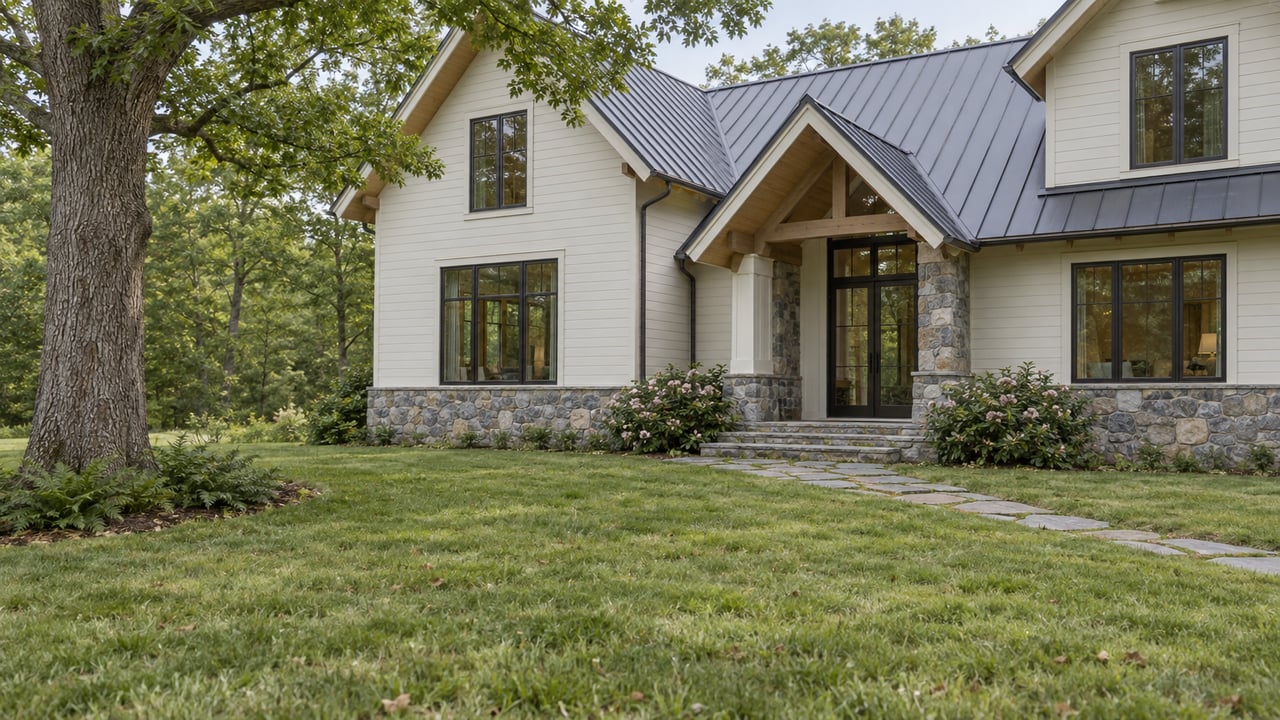
Biltmore Forest Doesn't Have a Median Home Price. It Has a Handful of Houses.
October 1, 2026
October 1, 2026
Between the first week of June and the second week of July 2026, five houses closed in Biltmore Forest. A 1,999-square-foot place on Holly Hill Road sold for $950,000. Three weeks later, a Stuyvesant Road estate went for $2,575,000. In between: $1,800,000 on Hilltop Road, $1,495,000 on Forest Road, $1,440,000 on Vanderbilt Road. Line those five up and the midpoint sits at $1,495,000.
That number will not match anything you find on a national listing portal. One portal's three-month window ending in May 2026 put the median at $1.3 million, a figure it reported as down 38.7 percent from the same stretch a year earlier. A different portal's June 2026 snapshot put the median at $2.35 million. A third source, looking at a trailing twelve months rather than a rolling quarter, reported a median of $1,515,524, down 49 percent from the year before, based on a count of just two closed sales in that window. Three real, dated, methodologically defensible numbers. Three different answers to what should be one question.
None of these sources made an error. The problem is structural. Biltmore Forest is a chartered town of roughly 1,500 residents inside a footprint of under three square miles, and in any given month the number of homes that actually change hands is small enough that a single estate closing can swing the reported median by hundreds of thousands of dollars. One portal counted 12 sales in May 2026, up from 6 a year earlier. Another counted 2 sales across an entire trailing twelve months. Both can be true at once if they are drawing their boundaries and their date windows differently, and that is precisely the point: in a market this thin, the boundary and the window are doing most of the work, not the underlying value of the real estate.
Compare that to a larger neighborhood where dozens of homes close every month. There, an outlier sale gets absorbed into a big enough sample that it barely moves the needle. In Biltmore Forest, an outlier is the sample. A $9.75 million legacy estate closing in the same quarter as three $1.2 million cottages will produce a median that looks nothing like the quarter before it, even if nothing about the neighborhood's underlying demand changed at all.
There is a second piece of evidence for this that most median-price headlines skip entirely: price per square foot. One portal's May 2026 data put the median at $517 per square foot, up 2.9 percent year over year. By August 2026, a separate portal's list-price data had that figure at $566 per square foot. Cost per square foot did not crash. It climbed through the same window in which the median "sale price" was reported down nearly 40 percent. That gap only makes sense if what changed was the mix of houses that happened to sell, not what any given square foot of Biltmore Forest is worth.
Here is the same five-sale window laid out plainly:
| Address | Sold | Price |
|---|---|---|
| Holly Hill Road | June 3, 2026 | $950,000 |
| Hilltop Road | June 3, 2026 | $1,800,000 |
| Stuyvesant Road | June 26, 2026 | $2,575,000 |
| Forest Road | July 7, 2026 | $1,495,000 |
| Vanderbilt Road | July 10, 2026 | $1,440,000 |
That is a five-week span with a top-to-bottom spread of 2.7 times. Widen the window by even a month in either direction and you would pull in different houses entirely, and the "median" would move again, for reasons that have nothing to do with buyers pulling back or the neighborhood cooling.
Zoom out to the county level and the contrast gets sharper. Buncombe County tied its own record for homes closing above $1 million in a single August, with 39 such sales in August 2026, matching the prior high set in August 2024. That is not a market in retreat. It is a market where the $1 million-plus tier stayed active through the summer, even as one neighborhood's own reported median swung by 40 percentage points depending on which quarter you asked about.
The reason a single sale carries so much weight here is that the top of the Biltmore Forest market is not hypothetical. In June 2026, a 1923 estate at 324 Vanderbilt Road known as New Gunston Hall came to market at $9.75 million. The home was built by a descendant of Founding Father George Mason as a deliberate echo of Mason's own Virginia estate, and it carries a footnote from 2014, when renovation work there fueled speculation that Barack and Michelle Obama were eyeing it as a post-presidency home, speculation the White House directly denied at the time. A short walk away, 436 Vanderbilt Road, a nine-acre parcel tied to the Vanderbilt and Cecil family line, came to market in 2026 for the first time in roughly fifty years, priced at $8.9 million. Neither of these is a typical listing. Both are the kind of property that, the moment either closes, will single-handedly reset whatever median gets reported for that quarter.
At the other end, the entry point into the neighborhood in an August 2026 snapshot sat just above $1.1 million, with active listings on Amherst Road and Buena Vista Road both priced in the $1.15 to $1.2 million range on lots under a third of an acre. Between that floor and the two estate-tier listings above it sits a nine-figure gap in a town where, by several accounts, well under twenty homes trade hands in a typical year. A house like Somerset, a 1925 estate designed by Charles Parker, the architect behind downtown Asheville's Grove Arcade, illustrates the same point from the supply side: houses of that vintage and standing rarely reach the market at all, which means whenever one does, it is not really comparable to anything else that sold that quarter.
If you are weighing Biltmore Forest against another Asheville-area neighborhood on the strength of a median price you found on a portal, you are comparing a real number from a deep, liquid market against a number from one of the thinnest markets in the region. The two are not doing the same job. A median in a market with hundreds of annual sales tells you something about typical value. A median in a market with a dozen or fewer tells you which handful of houses happened to close, which is a very different question with a very different answer each time someone asks it.
The buyer pool itself stays regional rather than national, which reinforces why volume never gets deep enough to smooth these swings out. Late 2025 search data showed that among Biltmore Forest owners shopping elsewhere, 55 percent were looking to stay within the greater Asheville metro while 45 percent searched beyond it, and national interest in moving into the town remained a rounding error against total home searches nationwide, concentrated mostly among buyers coming from Charlotte, Miami, and Atlanta. That is a small, steady, regional pool feeding a small, steady supply of houses, which is exactly the condition that makes a headline median unreliable from one quarter to the next.
The practical move is to ask for the specific comparable sales from the same calendar window you care about, in the same size and price tier, rather than trusting a single aggregate figure. A current, verified set of Biltmore Forest comparables is something we keep current on our own site, and it is worth pulling before you anchor to any number a portal handed you.
Does a falling median mean Biltmore Forest is losing value? Not on the evidence here. Price per square foot moved higher through the same stretch the median moved lower, which points to a change in which houses sold rather than a change in what any given house is worth.
How rare are the top-tier estate sales? Rare enough that a property like 436 Vanderbilt Road can sit with one family for roughly fifty years before it changes hands. When a sale like that closes, it does not represent "the market." It represents itself.
What's the real floor for buying into the neighborhood? As of an August 2026 snapshot, active listings on Amherst Road and Buena Vista Road put the entry point just above $1.1 million on lots under half an acre, well below the estate-tier prices that tend to dominate headlines.
Why do different sources report such different sale counts? Boundary definitions vary. Some pull data for the historic 1923 town limits only, others fold in adjacent gated developments that share the Biltmore Forest name. Ask which boundary your source used before comparing any figure across two different reports.
If you're weighing Biltmore Forest against another neighborhood and want the actual comparable sales behind the headline number, not just the portal snapshot, Mills + Coin can walk you through the current set at a private consultation in the downtown showroom.
Stay up to date on the latest real estate trends.

At Mills Coin & Co. Real Estate Group, we’re your trusted partner in navigating the Asheville real estate market. Whether you're buying, selling, or investing in property in Asheville, we're here to make the process smooth, seamless, and successful for you.
40 BILTMORE AVE ASHEVILLE, NC 28801